Line Shield Logic Puzzle
Reviews
Line Shield Logic Puzzle stands out for its focused mechanic: draw one continuous line to protect a character from hazards. The physics engine makes every shape matter, and the absence of failure penalties keeps the experience relaxed. Level variety in hazard direction prevents repetition. It suits casual players and puzzle fans who enjoy spatial reasoning, though those seeking fast action or complex progression may find it too minimal.
Description
The Core Drawing Mechanic
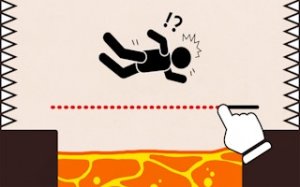
Line Shield Logic Puzzle gives you one tool: a single continuous line. A small character stands in a hazardous environment, and your line must keep it safe. Depending on how you shape it, the line works as a barrier, a ramp, or a deflector. The game does not prescribe one correct answer, so curves, angles, and loops are all valid if they solve the problem.
Physics and Real-Time Feedback
A simple physics engine makes each drawn line behave like a solid object. When hazards fall or roll, they collide with your line in real time. A straight line might block a falling block, while a curved line could redirect a rolling ball away from the character. This immediate cause-and-effect feedback helps you understand what went wrong and refine your approach on the next attempt.
Level Variety and Pacing
Each level introduces a unique setup. Some hazards drop from above; others come from the sides or below. That variety forces you to adapt your drawing strategy rather than reuse one shape. Difficulty rises gradually, but failure carries no penalty, so you can learn at your own pace without pressure.
Creative Freedom and Visual Style
You are not limited to simple lines. Zigzags, loops, boxes, and any shape you can imagine are allowed, as long as the line stays continuous. This freedom encourages spatial reasoning and creative thinking, and some puzzles accept multiple valid solutions. The clean, minimalistic visuals keep the character and hazards clearly visible, while the drawing interface responds intuitively. Calm background music supports the relaxed, no-pressure design.










Editorial Notes